- Can the AI see another church's data?
- No, and not because we promise to be careful. The assistant is only allowed to call six read-only summaries of your own records, and none of those summaries has a field for naming a church — so another congregation cannot be requested, because it cannot be addressed. Underneath, the query runs as a restricted database account that returns no rows at all unless your church is set. If that were ever left unset, the answer would be empty rather than someone else's.
- Can it read our pastoral care notes?
- No. The care summary can count how many cases are open and how long they have been open. The contents of a note — what a family told you in confidence — are never returned to the assistant. Likewise, giving summaries report totals and trends but never identify who gave what.
- Could it make up a number?
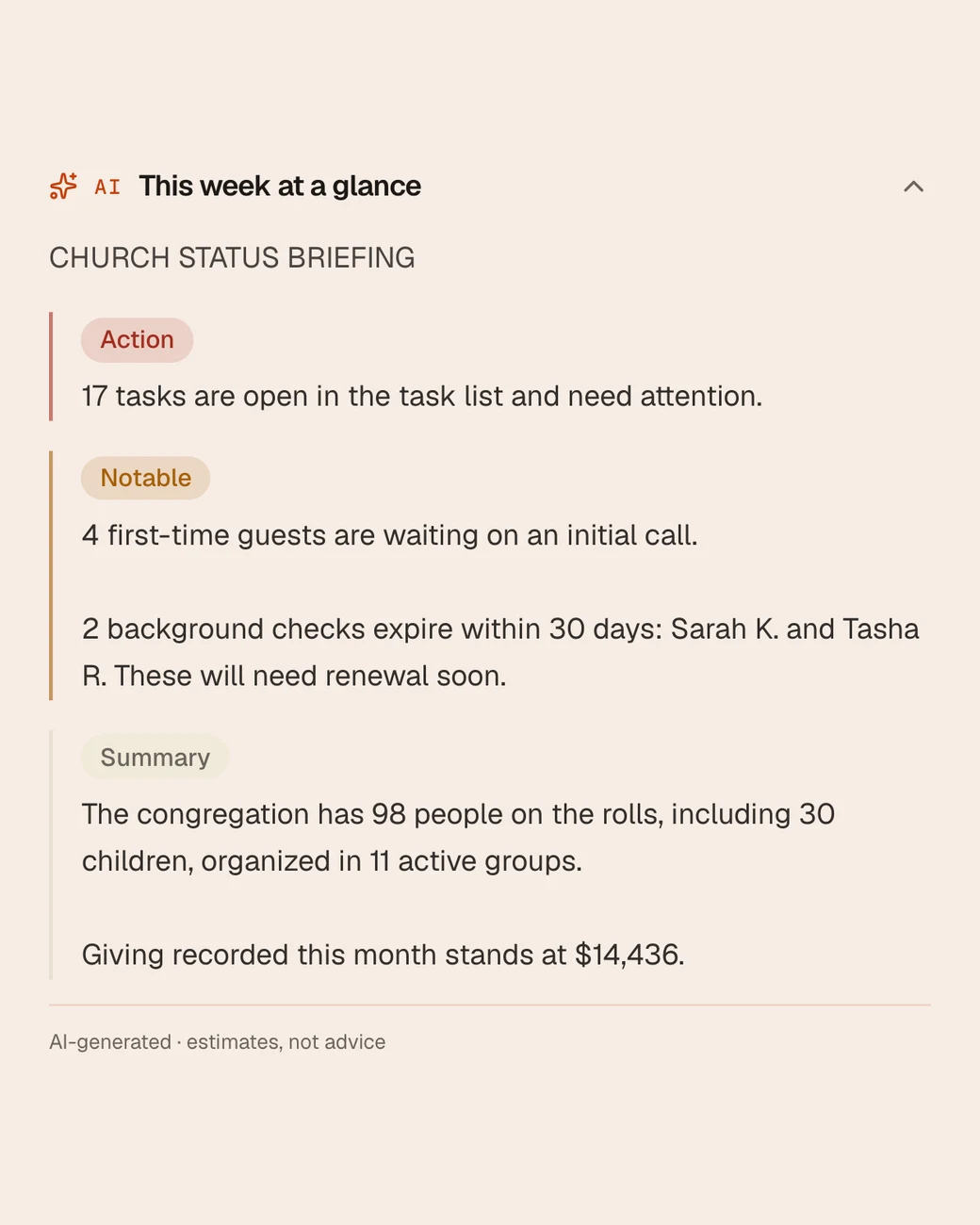
- It is not allowed to do arithmetic. Every figure it quotes is calculated by the same code that draws your dashboard. For the insight panels we go further: any number the model writes that is not one of your real figures causes the whole paragraph to be thrown away and replaced by a plain template. A wrong number cannot reach the page.
- Is our congregation's data used to train an AI model?
- No. Your question and the summaries needed to answer it are sent to our AI provider to produce the response, and they do not use it to train their models. We keep the question, the answer, and a record of which summaries were consulted, so an elder can audit later exactly what the assistant was told.
- Does it cost extra?
- No. 10 questions a month are included in the one $19 plan, and the insight panels are always on. There is no AI add-on to buy and no per-question billing.
- What happens when it doesn't know?
- It says so, and tells you which tab would show the answer. It will not speculate about a family's giving, guess a person's reason for being absent, or invent a policy. A tool that admits ignorance is the only kind worth putting near a congregation's records.